Fuel Station Management Software: Why Every Petrol Pump Needs It Today
Introduction
If you are associated with any Petrol Pump, Fuel Station or Oil Marketing Company (OMC) in Pakistan, you already know why Fuel Station Management Software is becoming essential. The rapid fluctuations in Petrol and Diesel prices over the last few years have completely changed the industry’s landscape.
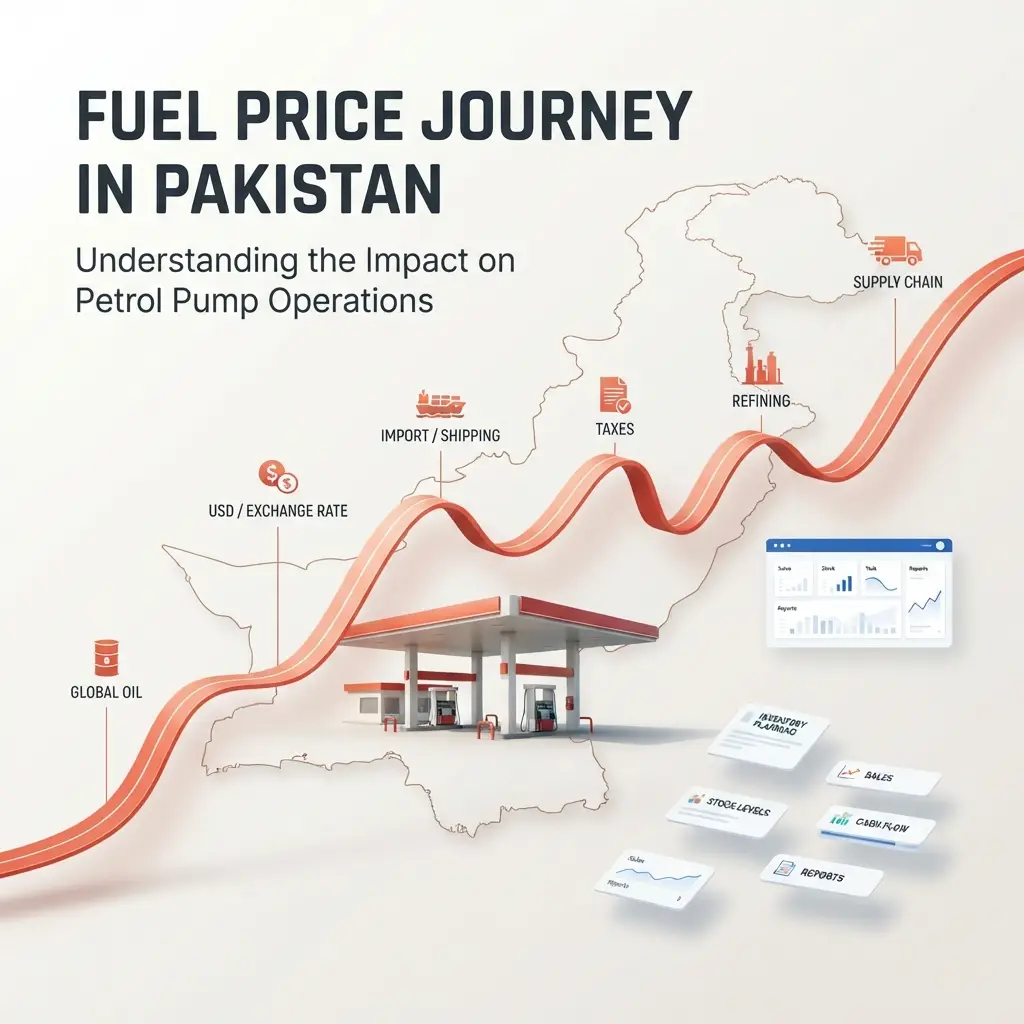
There was a time when there was no significant change in Fuel prices for months, but today the situation is such that new prices are expected to be announced every fortnight. Sometimes crude oil becomes expensive in the global market, sometimes the value of the Dollar increases, sometimes the government changes taxes or Petroleum Levy, and all these factors have a direct impact on the Fuel Industry of Pakistan.
But the question is not just about prices.
The real question is, when prices change frequently, how does it affect Petrol Pump Owners, Fuel Dealers, OMCs and businesses that sell millions of liters of Fuel daily?
And the more important question is, why are modern Fuel Station Management Software and Fuel Station Automation becoming a necessity in such situations?
We will understand this topic in detail in this blog series.
Importance of Fuel Industry in Pakistan’s Economy
A large part of Pakistan’s economy depends on Fuel.
Millions of vehicles, buses, trucks, motorcycles, agricultural machinery and industrial units use Petrol, High Speed Diesel (HSD) and other Petroleum Products every day.
Apart from this:
- Transportation Industry
- Logistics Companies
- Manufacturing Sector
- Agriculture
- Emergency Services
- Public Transport
All these sectors cannot continue their work without Fuel.
That is why Fuel is not just a product but the basis of the entire economy.
If Fuel is expensive, then:
- Transport costs increase.
- Food prices increase.
- Industrial production becomes expensive.
- Inflation increases.
That is, the change in fuel prices is not limited to the petrol pump, but its effects reach every Pakistani citizen.
The journey of fuel / petrol prices in the last 15 years
If we go back about fifteen years, petrol prices in Pakistan were relatively stable.
Prices did increase, but it happened a few times a year and the difference was not much.
Then over time, several factors emerged that completely changed the fuel market.
For example:
- Severe fluctuations in global oil prices
- Devaluation of the Pakistani rupee
- Increase in import costs
- Government tax policies
- Petroleum levy
- Global political tensions
- Supply chain problems
All these factors together made fuel prices uncertain.
Today, the situation is that petrol pump owners have to change their business decisions according to the new prices every few weeks.
Why do fuel prices keep changing in Pakistan?
Most people believe that the government increases prices at will.
The reality is much more complex than that.
Fuel prices depend on many different factors.
- Global Crude Oil Price
Pakistan imports most of its crude oil needs from abroad.
When crude oil is expensive in the global market, Pakistan also has to pay a higher price.
If the global price decreases, there is a possibility of a decrease in local prices, although other factors also affect this.
- Value of the Dollar
Oil imports in Pakistan are in US Dollars.
If the Dollar becomes expensive, even if the global oil price does not increase, the cost of imports increases.
This results in an increase in local fuel prices.
That is why the relationship between the Dollar and the Fuel Industry is extremely important.
- Freight and Shipping Costs
Crude oil is not only purchased, but also Shipping, Insurance and Freight Charges are paid to deliver it to Pakistan.
If global shipping costs increase, the overall cost of fuel also increases.
- Refining Cost
Crude oil cannot be used directly.
It is processed in refineries to produce petrol, diesel and other products.
This process also affects the price.
- Taxes and Petroleum Levy
The government also collects various taxes and petroleum levies.
This component sometimes significantly increases the fuel price.
That is why the public often considers the oil market alone responsible for the price increase, although the tax structure also plays an important role.
What is the role of OGRA?
The Oil and Gas Regulatory Authority (OGRA) is the body that monitors the fuel industry in Pakistan.
The main duties of OGRA include:
- Monitoring the Fuel Market
- Ensuring Quality Standards
- Monitoring Distribution
- Giving various suggestions to the government
- Assisting in the implementation of Industry Regulations
Although the government announces the final price, OGRA makes its recommendations based on market data and various factors.
That is why the role of OGRA in the Fuel Industry
It is considered very important.
When prices increase, it is not only the consumer who is affected
Most news only focuses on public reaction.
But the fact is that the biggest impact of a change in fuel price is on the business level.
For example:
A Petrol Pump Owner has to:
- Update his pricing with every price change.
- Keep track of the current stock.
- Make new purchase planning.
- Update reports.
- Verify inventory.
- Reorganize cash flow.
If all these tasks are done manually, the chances of errors increase manifold.
Impact of fuel price fluctuations on business
Frequently changing prices is not just a problem of accounting.
The effects are much deeper.
Inventory planning becomes difficult.
When to buy?
How much stock to keep?
How quickly to order new supply?
All these decisions become more complex.
Profit Margin is affected.
If a business does not have accurate data, even a minor error can cause financial loss.
Decision Making slows down.
When reports are not available on time, management cannot make timely decisions.
Operational Risk increases.
There is always a possibility of human errors in manual processes.
Especially when thousands of liters of fuel are being sold daily.
Why is the Fuel Industry in Pakistan rapidly becoming digital?
Like the rest of the world, the Fuel Industry in Pakistan is also slowly moving towards Digital Transformation.
The main reason for this is not just Technology but Business Control.
Today, large Fuel Businesses do not only look at Sales but also:
- Live Inventory
- Tank Levels
- Sales Reports
- Nozzle Monitoring
- Cash Position
- Business Analytics
Want to see everything in Real-Time.
This is why the importance of Fuel Station Management Software is constantly increasing.
Why is Fuel Station Management Software becoming important?
Today’s Petrol Pump is not just a place to sell Fuel.
It is a complete business unit.
Where daily:
- Thousands of Transactions take place.
- Different Products are sold.
- Multiple employees work.
- Different Shifts are run.
- Stock is constantly changing.
- Reports are generated.
In such an environment, manual management can not only prove difficult but also dangerous.
That is why modern Fuel Station Management Software helps in organizing the business under a centralized system.
It not only keeps Sales Records but also integrates important areas like:
- Inventory Management
- Sales Monitoring
- Dashboard Reporting
- Accounts
- Vendor Management
- HR Management
- ATG Integration
Now the question arises that who is the most pressured by all these situations?
The answer is Petrol Pump Owners, Fuel Station Managers and Oil Marketing Companies (OMCs).
Generally, people think that the job of a Fuel Station is only to sell Fuel, but the reality is much different. A modern fuel station is actually a complete business enterprise, where not hundreds but thousands of decisions are made every day. If the right information for these decisions is not available in time, then losses are almost certain.
Running a petrol pump is not as easy as it used to be
Ten or fifteen years ago, the methods of running a petrol pump were relatively simple.
- Sales were low.
- Competition was limited.
- Manual registers were considered sufficient.
- There was not much complexity in daily calculations.
But today the situation has completely changed.
An average fuel station daily:
- Hundreds of vehicles arrive.
- Fuel is sold from different nozzles.
- Different products such as lubricants and additives are also sold.
- Several employees work in different shifts.
- Both cash and digital payments are received.
- Various reports are generated.
Now if all these tasks are done only manually, the possibility of errors increases.
The biggest problem: Lack of visibility
Often, Petrol Pump Owners have the same problem.
They get a report at the end of the day, but they don’t have a complete picture of what actually happened throughout the day.
For example:
- At what time did the highest sales occur?
- Which nozzle was used the most?
- Which shift performed better?
- When did the difference in stock occur?
- Why did the difference in cash and sales occur?
If these questions are not resolved on time, the business gradually starts to lose money.
That is why Real-Time Monitoring is being considered a basic need in the Fuel Industry today.
Fuel Theft and Pilferage – A Silent Loss
The biggest challenge for many Petrol Pump Owners in Pakistan is Fuel Theft and Pilferage.
This loss is not always obvious.
Often, it is only a few liters of difference per day.
The owner thinks it is a minor matter.
But if there is a difference of five or ten liters per day, then over the course of a year the same difference can reach thousands of liters of fuel.
This not only causes financial losses but also affects business confidence.
Why does Stock Mismatch happen?
This problem is common at many Fuel Stations:
The system is showing one thing while the physical stock is something else.
There can be several reasons for this.
- Manual Entries
- Incorrect Measurement
- Delayed Data Entry
- Fuel Leakage
- Pilferage
- Calculation Errors
Until the exact reason is known, the problem keeps coming up again and again.
That is why modern Inventory Management System automatically records every transaction so that the stock is always correct.
Manual Reporting is now slowing down the pace of business
Many Fuel Stations still prepare reports manually.
It also takes more time and the chances of errors also increase.
Some of the important reports prepared daily are:
- Daily Sales Report
- Shift Wise Report
- Nozzle Wise Report
- Product Wise Report
- Inventory Report
- Cash Report
If all these reports are manual, the management does not get the correct picture on time.
The result is that there is a delay in decision making.
Sales Data is there, but not Business Intelligence
Just knowing Sales is not enough.
The real question is what does Sales mean?
For example:
- Which product is increasing in demand?
- Which shift is performing better?
- When is fuel sales high?
- Which product is selling less?
- Where is the profit margin high?
All this information can only be provided by a modern Dashboard and Reporting System.
Multi-Shift Management Issues
Most petrol pumps operate 24 hours a day.
Namely:
Morning Shift
Evening Shift
Night Shift
Each shift has its own Sales, Cash and Inventory.
If Shift Handover is not strong, then differences start to arise.
Many times the next shift blames the previous shift.
And in the end, the real problem does not come to light.
That is why modern Shift Wise Sales Monitoring creates transparency in the business.
Cash Management is also a big challenge
Cash Management is very important for fuel stations that transact millions of rupees daily.
In case of adopting the manual method:
- Cash Counting takes time.
- Human Error increases.
- Verification becomes difficult.
- Accounting Delay occurs.
If Sales and Cash are not linked to each other automatically, discrepancies start arising.
Why has Inventory Planning become more important than before?
When fuel prices change frequently, only the current stock is not enough.
Management also has to think about:
- When should the next delivery be ordered?
- How much quantity should be purchased?
- How much fuel is available in which tank?
- What should be the reorder level?
If this planning is done by estimation, either unnecessary stock accumulates or there is a risk of supply running out.
Customers’ expectations have also changed
Today’s customers do not just buy fuel.
They want:
- Fast Service
- Accurate Billing
- Professional Management
- Less Waiting Time
- Better Customer Experience
If the processes inside the Petrol Pump are slow, the customer prefers to go elsewhere.
That is why modern technology is not only important for Management but also for Customer Satisfaction.
What problems do Oil Marketing Companies (OMCs) face?
The challenge for OMCs is not limited to just one Petrol Pump.
They have to manage many Stations simultaneously.
It is important for them to:
- Live Sales of all Stations can be seen.
- Inventory Position can be known.
- Fuel Dispatch Track.
- Reports are available in one place.
- Performance of each Station can be compared.
If each Station uses a separate system, it becomes extremely difficult to manage the entire Network.
Data is there, but not Actionable Information
Today, many businesses have Data but are not able to use it.
A good Fuel Station Management Software does not just store data but also converts it into business insights.
For example:
- Which station is giving the best performance?
- Where is the fuel loss higher?
- Which product is decreasing in sales?
- Which branch needs more attention?
This information helps management to make better decisions.
Technology is no longer a luxury, it is a business requirement
A few years ago, many people thought that automation was only for big companies.
But today the situation is different.
If even a medium-sized petrol pump sells thousands of liters of fuel daily, it also needs:
- Accurate Inventory
- Live Monitoring
- Reporting
- Business Control
And all this is not possible manually.
Why is fuel station automation becoming necessary?
Automation does not mean just using a computer
But it is about creating a system where:
- Sales are recorded automatically
- Inventory is updated automatically
- Reports are generated automatically
- Dashboard is live
- Management can see the business from anywhere.
This is the change that is transforming the Fuel Industry worldwide.
How do solutions like EzPump help here?
Modern Fuel Station Management Software like EzPump try to solve all these problems on a single platform.
For example:
- Real-Time Sales Monitoring
- Inventory Management
- Dashboard Analytics
- Accounts Management
- Vendor Management
- HR Management
- Reports Management
- Machine Integration
- ATG Integration
- ERP Integration
When all the modules are connected to each other, management does not have to wait for separate reports for each decision.
The future of Fuel Station Automation and how modern software is changing the business?
In the first two parts, we discussed the situation of Fuel Prices in Pakistan, the impact of the global market, the role of OGRA, and the practical problems faced by Petrol Pump Owners.
Now the question is, if running a business manually has become so difficult, what is the solution?
The answer is the same all over the world:
Fuel Station Automation
Today, modern Fuel Stations do not just sell Fuel but also manage every activity digitally. That is why Fuel Station Management Software has now become not just a software but the central system of the entire business.
What is Fuel Station Automation?
In simple words, Fuel Station Automation is a system that automates all the important daily tasks of a Fuel Station on a single platform.
This may include:
- Fuel Sales Monitoring
- Inventory Management
- Tank Monitoring
- Dashboard Reporting
- Accounts Management
- HR Management
- Vendor Management
- Machine Integration
- ATG Integration
- ERP Integration
The aim is not only to save time but also to make the business more secure, transparent and organized.
How does a modern Fuel Station Management Software work?
Imagine that you have four different Petrol Pumps in Lahore, Faisalabad, Multan and Karachi.
If each Pump is running separately, then:
- Sales will have to be viewed separately.
- Stock should be checked separately.
- Cash should be verified separately.
- Reports should be prepared separately.
But if there is a Centralized Fuel Station Management Software, all the information can be available on a single Dashboard.
Management can see the status of any station at any time.
Why is Real-Time Monitoring important?
In the old system, Management had to wait till evening to see how many sales were made today.
But in modern business, decisions are made at that time, not at the end of the day.
That is why Real-Time Monitoring has now become a basic necessity.
Through it, one can see:
- Live Sales
- Nozzle Activity
- Current Inventory
- Cash Position
- Shift Performance
- Daily Targets
Which makes it easy to take quick decisions.
Dashboard — Live picture of the business
A good Dashboard does not just show beautiful charts but also helps Management understand the complete situation of the business.
For example:
- Today’s Total Sales
- Product Wise Sales
- Tank Levels
- Outstanding Payments
- Payables & Receivables
- Inventory Status
- Cash Position
- Top Selling Products
When all this information is available on a single screen, decision-making becomes faster and more effective.
Inventory Management can no longer be based on estimates
Inventory is one of the most valuable assets in the Fuel Industry.
If there is no complete control over Inventory, then:
- Fuel Loss can increase.
- Theft risk increases.
- Stock Planning is affected.
- Customer Service can be affected.
That is why a modern Inventory Management System records every inward and outward movement.
Through this:
- Product Wise Stock
- Reorder Level
- Stock Verification
- Tank Balance
- Product Movement
Can be easily seen.
Benefits of ATG Integration
Today, Automatic Tank Gauge (ATG) is being used in modern Fuel Stations around the world.
With the help of ATG:
- Tank Level is automatically detected.
- Water Detection is possible.
- Temperature Monitoring is done.
- Live Fuel Quantity can be viewed.
When ATG Integration is combined with Fuel Station Management Software, Inventory becomes more accurate.
Sales Management has become smarter than ever
It is not enough to just know how many sales were made today.
Management should also know:
- Which Nozzle made how many sales?
- Which Product is in high demand?
- Which Shift performed better?
- What are the Daily, Weekly and Monthly Trends?
The modern Sales Management Module provides all this information in a few seconds.
Reports that make decisions easier
Every successful business makes decisions on data, not on estimates.
That is why modern reporting is extremely important.
For example:
- Daily Sales Report
- Product Wise Report
- Shift Wise Report
- Nozzle Wise Report
- Inventory Report
- Financial Report
- Performance Report
All these reports show the real picture of the business to the Management.
Accounts Management also in one place
Accounts at many Fuel Stations are in separate software while Sales in another system.
This requires re-entering data.
The modern Accounts Management Module eliminates this problem.
This can include:
- Cash Receipt Voucher
- Cash Payment Voucher
- Bank Receipt
- Bank Payment
- Journal Voucher
- Chart of Accounts
- Financial Reports
This makes accounting easier and more accurate.
Why is HR Management important?
A Fuel Station is not just run by machines but by people.
If Staff Management is weak, even the best business can be affected.
That is why the modern HR Module includes:
- Employee Records
- Attendance
- Salary Management
- Overtime
- Leave Management
- Staff Performance
- Shift Planning
Having all this information in one place makes Human Resource Management easier.
Vendor Management keeps the business organized
Each Fuel Station works with different Vendors.
For example:
- Fuel Suppliers
- Lubricant Suppliers
- Equipment Vendors
- Maintenance Companies
If Vendor Data is kept in different registers, then tracking becomes difficult.
Vendor Management Module:
- Purchase Records
- Vendor Details
- Product History
- Outstanding Payments
- Purchase Reports
Stores them in one place.
Why is ERP Integration Important?
Large OMCs and Enterprise Businesses already use different ERP Systems.
If the Fuel Station Software cannot connect with them, then the data has to be re-entered.
That is why ERP Integration has become a very important feature in modern software.
Making Multi-Station Operations Easy
Today, many businesses are running not one but dozens of Fuel Stations.
It is important for them to:
- Live Sales of all Branches can be seen.
- Performance of each Station can be compared.
- Stock Movement Monitor.
- Decisions can be made from the central office.
Centralized Fuel Management is used for this purpose.
A business does not succeed by collecting data alone.
Real success occurs when data is converted into decisions.
For example:
- Which station is giving more profit?
- Where is loss increasing?
- Which product is decreasing in demand?
- Which vendor is giving better performance?
This information helps management in planning for the future.
The Future of Fuel Industry in Pakistan
Pakistan’s fuel industry is rapidly moving towards Digital Transformation.
In the coming years:
- There will be more automation.
- Smart Monitoring will become common.
- Cloud-Based Systems will increase.
- Mobile Access will become essential.
- Artificial Intelligence-based Analytics will be used.
- Predictive Inventory Management will be introduced.
A business that does not change itself with time will find it difficult to stay competitive.
How is EzPump a part of this transformation?
Keeping in mind the needs of the modern Fuel Industry in Pakistan, EzPump provides a Fuel Station Management Software that helps Fuel Stations and OMCs manage their daily operations more effectively.
EzPump brings various important modules on a single platform, including:
- Dashboard
- Sales Management
- Inventory Management
- Reports Management
- Accounts Management
- HR Management
- Vendor Management
- ATG Integration
- ERP Integration
- Real-Time Monitoring
Thus, it is easy for Management to see the complete status of the business from a centralized platform instead of different systems.
Technology is not just a convenience, it is a business requirement
A few years ago, automation was considered an additional convenience, but today it has become a business requirement.
In the era of constant changes in fuel prices, increasing operational costs, stringent regulatory requirements and intense competition, only those businesses can move forward quickly that make decisions based on data.
That is why modern Fuel Station Management Software does not only solve current problems but also prepares the business for the future.
Conclusion
Pakistan’s fuel industry has entered a new era. Where earlier success depended only on selling more fuel, now success also depends on Operational Efficiency, Accurate Data, Real-Time Monitoring and Smart Decision Making.
Problems like constant changes in fuel prices, rising costs, inventory challenges, fuel loss and manual management can no longer be solved by traditional methods.
That is why Fuel Station Automation and modern Fuel Station Management Software have become the need of the hour.
Whether you are running a single Petrol Pump or a network of multiple Fuel Stations across the country, the right technology can provide you with greater transparency, better control, faster decisions and effective business performance.
In the changing fuel industry, only those organizations will succeed that will adopt the change in time, modernize their operations, and build their business on digital foundations according to the requirements of the future.