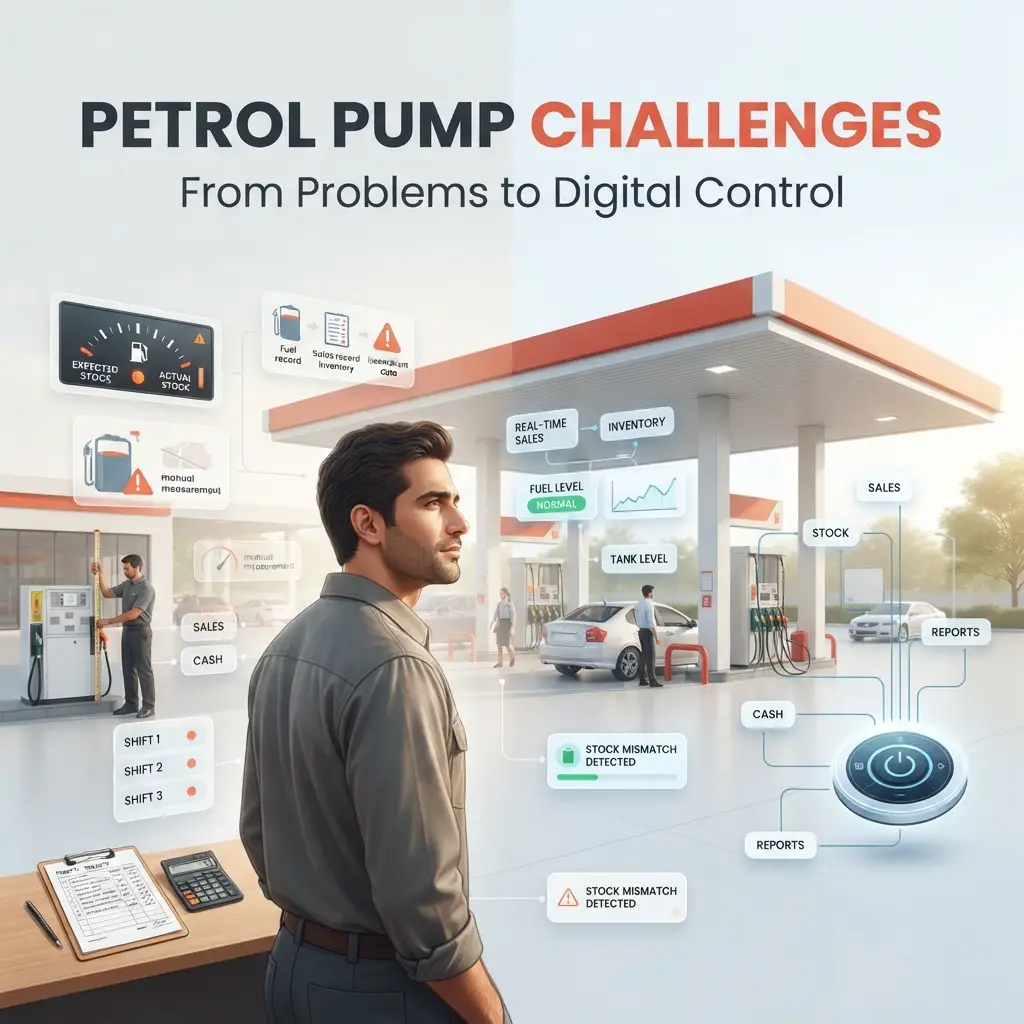
Introduction
Running a petrol pump in Pakistan looks simple from the outside. Fuel comes in, fuel goes out, and sales are recorded. But anyone who actually manages a fuel station knows—it’s far from simple.
Behind the scenes, there’s constant pressure.
- Stock needs to match sales
- Cash needs to align with records
- Staff needs to be monitored
- Losses need to be controlled
And all of this has to happen every single day, without mistakes.
The problem is, most petrol pumps are still running on outdated, manual systems. And these systems are no longer enough to handle the challenges of today’s fuel business.
That’s where technology in fuel station management is making a real difference.
The Everyday Reality of Petrol Pump Owners
Let’s be real for a moment.
If you’re a petrol pump owner or manager, your day doesn’t end when the station closes. You’re constantly thinking:
- “Are the sales figures correct?”
- “Is my stock accurate?”
- “Is there any fuel loss happening?”
- “Can I fully trust the reports?”
This constant uncertainty is the biggest hidden problem.
And it comes from one core issue—lack of control and visibility.
Major Challenges Petrol Pump Owners Face
- Fuel Loss and Pilferage
This is the most common and most damaging issue.
Fuel loss can happen due to:
- Leakage
- Measurement errors
- Theft or pilferage
- Reporting gaps
The worst part? These losses are often small and daily, which makes them hard to detect—but over time, they become significant.
- Inaccurate Stock Management
Most fuel stations still rely on manual dipping to measure tank levels.
But this method is not always reliable:
- Human estimation varies
- Measurements are not precise
- Timing affects readings
This leads to confusion when stock doesn’t match sales.
- Lack of Real-Time Monitoring
Manual systems only provide end-of-day reports.
That means:
- You don’t know what’s happening during the day
- You can’t catch issues instantly
- You react late instead of acting early
In a fast-moving business, delayed information is a serious disadvantage.
- Sales and Cash Mismatch
Another common issue is when:
- Sales reports don’t match cash
- Entries are incomplete
- Calculations are incorrect
This creates accounting problems and trust issues within the team.
- Over-Dependence on Staff
Petrol pump operations rely heavily on staff honesty and accuracy.
But without a proper system:
- There is no way to verify everything
- Mistakes or manipulation can go unnoticed
- Owners lose control when off-site
- Complex Multi-Shift Operations
Most petrol pumps operate in multiple shifts.
Without a system:
- Tracking shift-wise performance is difficult
- Responsibility becomes unclear
- Errors cannot be traced easily
- Manual Reporting and Time Wastage
A lot of time is spent on:
- Writing reports
- Calculating totals
- Cross-checking data
This slows down operations and increases the chance of errors.
Why These Problems Exist?
All these challenges come back to one root cause:
Manual and disconnected systems.
When sales, stock, cash, and reporting are handled separately, gaps are inevitable.
And where there are gaps, there are losses.
The Real Cost of These Challenges
These issues don’t just create inconvenience—they directly impact your business.
- Profit margins shrink
- Operational costs increase
- Decision-making becomes weak
- Stress levels go up
- Growth becomes difficult
Most importantly, you lose confidence in your own data.
How Technology Is Changing Fuel Station Management?
This is where technology in fuel station management steps in.
Instead of relying on manual processes, modern systems connect everything into one platform.
They provide:
- Real-time data
- Automated tracking
- Accurate reporting
- Complete visibility
Technology doesn’t just make things easier—it makes them reliable.
Key Technological Solutions for Petrol Pumps
- Real-Time Sales Monitoring
Track every sale as it happens:
- Nozzle-wise
- Shift-wise
- Product-wise
No waiting. No guessing.
- ATG Integration (Automatic Tank Gauging)
Replace manual dipping with digital tank measurement.
- Accurate fuel levels
- Real-time updates
- Instant discrepancy detection
- Inventory Management Systems
Automatically track:
- Fuel in
- Fuel out
- Remaining stock
Everything stays updated without manual effort.
- Centralized Dashboard
A single screen that shows:
- Sales
- Stock
- Cash
- Reports
You don’t need multiple registers or reports anymore.
- Automated Reporting
Generate reports instantly:
- Daily
- Weekly
- Monthly
No calculations. No errors.
- Alerts and Notifications
Get notified when something goes wrong:
- Stock mismatch
- Unusual sales patterns
- Inventory issues
Practical Benefits of Using Technology
- Reduced Fuel Loss
Discrepancies are identified early, preventing long-term losses.
- Full Business Control
You can monitor your station anytime, from anywhere.
- Better Accountability
Every action is recorded and traceable.
- Faster Operations
No manual work slows you down.
- Improved Decision-Making
You rely on real data, not assumptions.
- Peace of Mind
You finally feel in control of your business.
Why this Matters in Pakistan?
Fuel station owners in Pakistan face unique challenges:
- Tight margins
- Increasing operational costs
- Limited system adoption
- High dependency on staff
In such conditions, even small inefficiencies can have a big impact.
Technology helps bridge this gap by:
- Bringing structure to operations
- Improving accuracy
- Reducing dependency on manual work
Why Choosing the Right Solution Matters?
Not every system is built for petrol pumps.
A reliable solution must:
- Understand real-world station operations
- Support local business needs
- Integrate with fuel machines and ATGs
- Be simple and practical to use
A complicated system can create more problems than it solves.
Where EzPump Comes in?
This is where EzPump fits naturally.
It’s designed specifically for petrol pumps in Pakistan, keeping real challenges in mind.
EzPump connects:
- Sales
- Inventory
- Tank monitoring
- Accounts
- Reports
All in one system.
It doesn’t just digitize operations—it simplifies them.
The Bigger Picture
The fuel industry is evolving.
Customers expect better service. Authorities expect better compliance. Owners expect better control.
Manual systems cannot keep up with these expectations.
Technology is no longer a luxury—it’s becoming a necessity.
Conclusion
Petrol pump owners deal with more challenges than most people realize.
Fuel loss, stock mismatch, staff dependency, and reporting issues are part of daily operations. But continuing with manual systems only makes these problems worse.
Technology offers a clear way forward.
With the right system in place, petrol pump owners can move from uncertainty to control, from guesswork to clarity, and from losses to better profitability.
The shift has already started.
The real question is—when will you make the move?