Introduction
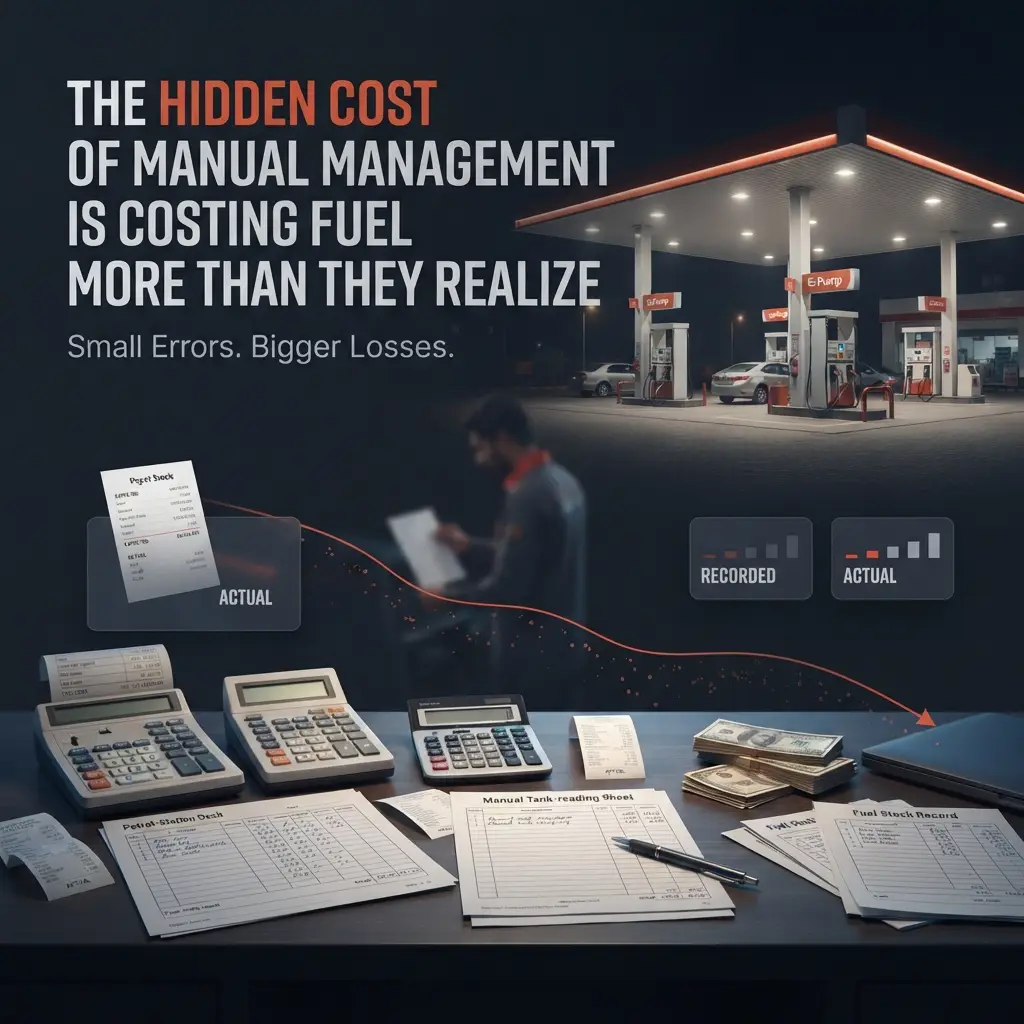
If you walk into most petrol pumps across Pakistan, you’ll notice something familiar—registers on desks, staff noting down sales, and someone dipping tanks to check fuel levels. For years, this has been the “normal” way of running a fuel station.
And honestly, it feels like it works.
But here’s the uncomfortable truth: manual pump management is quietly costing fuel stations more than they realize.
Not in obvious ways. Not in one big hit. But in small, daily gaps—errors, delays, miscalculations, and unnoticed losses—that slowly eat into profits. By the time these issues become visible, the damage is already done.
The Illusion of Control in Manual Systems
Most petrol pump owners believe they are in control because they receive daily reports.
- Sales figures are shared
- Tank levels are checked
- Cash is counted
- Staff gives updates
On the surface, everything seems aligned.
But ask yourself this:
Do you know what’s happening at your pump right now?
Manual systems don’t provide real-time visibility. They provide after-the-fact summaries. And that delay is where problems start.
Understanding Manual Pump Management
Manual pump management refers to running fuel station operations without a centralized digital system. It includes:
- Handwritten sales entries
- Manual nozzle readings
- Physical tank dipping
- Paper-based stock tracking
- Register-based accounting
- Verbal or informal staff reporting
These methods depend entirely on human accuracy, discipline, and honesty.
And while your team may be experienced, the system itself is weak.
Why Manual Pump Management Fails
- No Real-Time Visibility
Manual systems only show you what already happened, not what’s happening now.
If a discrepancy occurs during a shift, you won’t know until the end of the day—or sometimes even later. By then, tracing the issue becomes difficult.
- Human Error Is Inevitable
No matter how careful your staff is, mistakes happen:
- Wrong entries
- Miscalculations
- Missed records
- Incorrect totals
Even small errors, repeated daily, create major financial gaps over time.
- No Direct Link Between Sales and Stock
One of the biggest flaws in manual systems is the disconnect between:
- Fuel sold (sales data)
- Fuel available (tank stock)
Without a system linking these two, discrepancies go unnoticed.
- Lack of Accountability
When multiple shifts operate with manual reporting:
- Who is responsible for a mismatch?
- Which shift caused the issue?
- When did it happen?
Without digital tracking, accountability becomes unclear.
- Dependency on Staff
Manual systems force owners to rely completely on staff for:
- Accurate reporting
- Honest entries
- Proper handling
This creates risk—especially when you’re not physically present.
The Hidden Costs of Manual Pump Management
Now let’s talk about what really matters—the cost.
Not the visible cost. The hidden one.
- Daily Fuel Loss That Goes Unnoticed
Even a loss of:
- 2–3 liters per day
- Across multiple nozzles
- Over 30 days
This becomes a significant financial hit.
And the worst part? You may never know exactly where it happened.
- Stock Mismatch and Confusion
Manual dipping is not always accurate. Factors like:
- Tank shape
- Human estimation
- Measurement inconsistency
All lead to incorrect stock data.
This affects ordering, planning, and reconciliation.
- Cash vs Sales Mismatch
Without a proper system:
- Cash may not match sales
- Records may not align
- Errors go unnoticed
This creates trust issues and accounting problems.
- Time Wastage
Manual work takes time:
- Writing entries
- Calculating totals
- Checking records
- Fixing mistakes
Time that could be spent improving operations is lost in paperwork.
- Stress and Mental Load
Let’s be honest—manual systems create stress.
You’re constantly thinking:
- “Are the numbers correct?”
- “Is stock accurate?”
- “Can I trust this report?”
That uncertainty affects decision-making.
Real-Life Scenario (Common in Pakistan)
Let’s take a simple example.
A petrol pump owner receives:
- Daily sales report
- Tank reading
- Cash summary
Everything looks fine.
But over a month:
- Stock doesn’t match purchases
- Cash doesn’t align perfectly
- Profit seems lower than expected
No clear reason. No clear answer.
This is exactly how manual systems fail—silently.
The Turning Point: Digital Fuel Management
To fix these issues, fuel stations are shifting toward digital fuel management.
Instead of relying on manual inputs, digital systems automate and connect operations.
Everything becomes:
- Real-time
- Accurate
- Transparent
- Traceable
What Changes with Digital Systems?
The difference is not small—it’s fundamental.
Before (Manual):
- Data is delayed
- Errors are common
- Losses are hidden
- Control is limited
After (Digital):
- Data is live
- Accuracy improves
- Losses are visible
- Control is centralized
Key Features That Replace Manual Systems
Real-Time Sales Monitoring
Track nozzle-wise, shift-wise, and product-wise sales instantly.
ATG Integration (Automatic Tank Gauging)
Tank levels are measured digitally—no more manual dipping.
Automated Inventory Management
Fuel stock updates automatically with every transaction.
Centralized Dashboard
All information is available in one place.
Accurate Reporting
Generate reports without manual calculations.
Alerts & Discrepancy Detection
Identify issues early before they grow.
Practical Benefits for Petrol Pump Owners
- Full Control
You know what’s happening at your pump anytime.
- Reduced Losses
Discrepancies are detected quickly.
- Better Accountability
Every action is recorded.
- Faster Operations
No manual paperwork.
- Peace of Mind
You don’t have to “guess” anymore.
Why This Shift Matters in Pakistan?
Pakistan’s fuel station environment is challenging:
- Margins are tight
- Costs are increasing
- Monitoring is limited
- Staff dependency is high
In such a setup, even small inefficiencies matter.
Manual systems cannot keep up with these demands.
Digital fuel management brings:
- Structure
- Accuracy
- Control
- Transparency
Why Choosing the Right Solution Matters?
Not every system will work in real conditions.
A proper solution must:
- Understand petrol pump workflows
- Support local operations
- Integrate with hardware (ATG, machines)
- Be simple to use
A complicated system is just another problem.
Where EzPump Fits in?
This is where EzPump makes a real difference.
It’s built specifically for petrol pumps in Pakistan. Not adapted. Not generic.
EzPump focuses on real problems:
- Fuel loss
- Stock mismatch
- Reporting delays
- Lack of control
And solves them with a system that is:
- Simple
- Practical
- Reliable
Everything—sales, stock, accounts, reports—comes into one dashboard.
The Real Question
It’s not whether manual systems work.
They do.
The real question is:
At what cost?
If your system is:
- Hiding losses
- Delaying information
- Increasing dependency
- Limiting control
Then it’s costing you more than you think.
Conclusion
Manual pump management has been the standard for years. But the industry has changed.
Today, control, accuracy, and transparency are not optional—they are essential.
The longer a fuel station relies on manual systems, the more it risks losing—slowly, quietly, and consistently.
Switching to digital fuel management is not just an upgrade.
It’s a decision to take back control of your business