Introduction
Running a petrol pump in Pakistan often feels like managing five different businesses at once.
You’re tracking sales from nozzles, checking fuel stock in tanks, handling cash, managing staff, and reviewing reports—all separately. And the problem? None of these systems truly “talk” to each other.
This is where most issues begin.
When sales, stock, and accounts are disconnected, even small gaps turn into daily confusion. That’s exactly why more fuel station owners are now moving toward fuel station management systems—a single platform that brings everything together.
The Real Problem: Disconnected Operations
Let’s break it down simply.
At a typical petrol pump:
- Sales are recorded separately
- Tank levels are checked manually
- Cash is managed in registers
- Reports are prepared at the end of the day
Each process works on its own.
But there’s no real connection between them.
And when systems are disconnected, questions start to arise:
- Does sales data match actual fuel stock?
- Is the reported stock accurate?
- Does cash align with sales?
- Which shift caused a discrepancy?
Without a unified system, these questions don’t have clear answers.
Why This Happens in Most Fuel Stations?
The issue isn’t lack of effort—it’s lack of integration.
Most petrol pumps still rely on:
- Manual entries
- Staff-based reporting
- Physical tank measurements
- End-of-day summaries
These methods create delays and inconsistencies.
For example:
- Sales may be recorded correctly, but stock may not match
- Tank readings may be taken at different times
- Cash counting may include human errors
Everything operates in isolation.
The Real-World Impact on Petrol Pumps
These gaps are not just technical—they directly affect your business.
- Stock Mismatch
One of the most common issues.
Sales show one number. Tank shows another.
Now you’re stuck figuring out:
- Is fuel missing?
- Is measurement wrong?
- Is reporting inaccurate?
- Fuel Loss and Leakage
Without linking sales to stock:
- Small losses go unnoticed
- Pilferage becomes hard to detect
- Daily discrepancies accumulate
- Cash Handling Problems
When sales and cash are tracked separately:
- Mismatches occur
- Records become unreliable
- Accountability weakens
- Delayed Decision-Making
By the time reports are ready:
- The issue has already passed
- You can’t take immediate action
- Constant Dependence on Staff
Without a system:
- You rely on staff for updates
- You can’t verify everything
- You lose control when off-site
The Need for One Integrated System
This is where the shift happens.
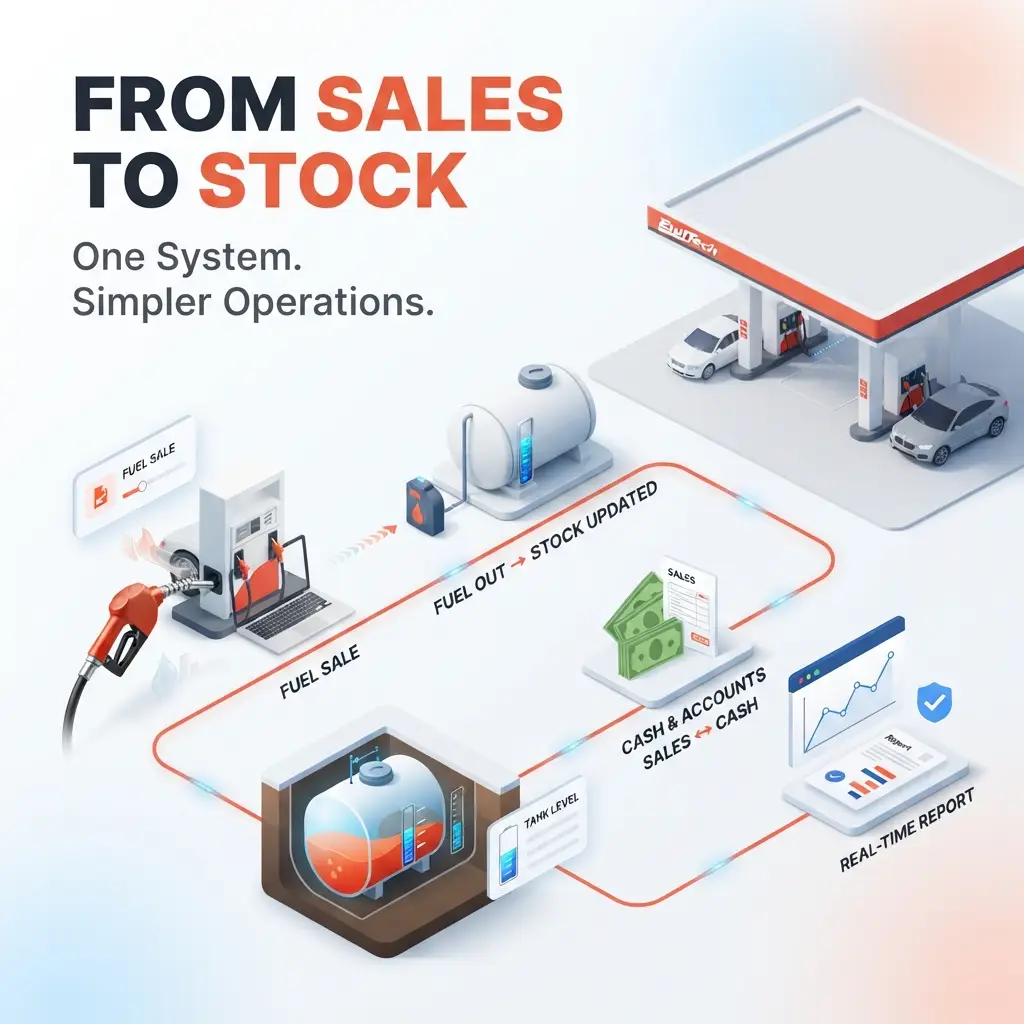
Instead of managing everything separately, fuel stations now use a fuel station management system that connects:
- Sales
- Inventory
- Tank levels
- Cash
- Reports
Into one platform.
No duplication. No confusion. No delay.
Everything works together.
How One System Simplifies Fuel Station Operations
When you bring everything into one system, operations become smoother automatically.
Here’s how:
- Sales and Stock Are Linked
Every sale directly impacts stock.
- Fuel sold → automatically deducted from inventory
- Tank levels → updated in real time
No need to match data manually.
- Real-Time Visibility
Instead of waiting for reports:
- You see live sales
- You see current stock
- You see cash position
All at once.
- Automated Inventory Tracking
Stock management becomes effortless:
- Fuel in (deliveries) recorded instantly
- Fuel out (sales) updated automatically
- Balance calculated in real time
- Centralized Dashboard
Everything is available on one screen:
- Sales performance
- Tank levels
- Cash flow
- Reports
No need to check multiple sources.
- Accurate Reporting
Reports are generated instantly:
- No manual calculations
- No errors
- No delays
Key Features of a Unified Fuel Station System
A proper system is designed to solve real operational problems.
Real-Time Sales Monitoring
Track every transaction as it happens.
ATG Integration
Tank levels are measured digitally, ensuring accuracy.
Inventory Management
Stock is always updated and visible.
Cash & Accounts Management
Sales and cash are aligned automatically.
Shift Management
Track performance shift-wise and assign responsibility.
Reporting & Analytics
Get clear insights without manual effort.
Practical Benefits for Petrol Pump Owners
- Clarity in Operations
No confusion between sales, stock, and cash.
- Reduced Losses
Discrepancies are visible immediately.
- Better Control
You don’t need to be physically present all the time.
- Faster Workflows
Everything happens automatically.
- Improved Accountability
Each action is recorded and traceable.
- Smarter Decisions
You act based on real data, not assumptions.
Why This Matters in Pakistan?
Fuel station operations in Pakistan face unique challenges:
- High dependency on staff
- Limited monitoring systems
- Tight profit margins
- Manual working environments
In such conditions, running disconnected systems is risky.
A fuel station management system brings structure and control without making operations complicated.
It aligns with real-world petrol pump workflows.
Why Choosing a Professional System Matters
Not every system can handle fuel station operations effectively.
You need a solution that:
- Understands petrol pump challenges
- Integrates with machines and ATGs
- Works in local conditions
- Is easy for staff to use
A complicated system can slow you down instead of helping.
Where EzPump Fits In
This is where EzPump comes into the picture.
EzPump is designed specifically for petrol pumps in Pakistan. It connects sales, stock, tanks, and accounts into one unified platform.
Instead of managing everything separately, EzPump brings everything together—simply and clearly.
It’s not just software. It’s a control system for your entire fuel station.
The Bigger Picture
Fuel station management is evolving.
Owners are moving away from:
- Manual systems
- Separate processes
- Delayed reporting
And shifting toward:
- Real-time monitoring
- Integrated systems
- Data-driven decisions
The difference is not just efficiency—it’s control.
Conclusion
Managing a petrol pump with disconnected systems is like trying to solve a puzzle with missing pieces.
Sales don’t match stock. Stock doesn’t match reports. And decisions are based on incomplete information.
A single, integrated fuel station management system changes everything.
It connects operations, removes confusion, and gives you complete visibility over your business.
From sales to stock, everything becomes simple, accurate, and controlled.
And once you experience that clarity, there’s no going back.