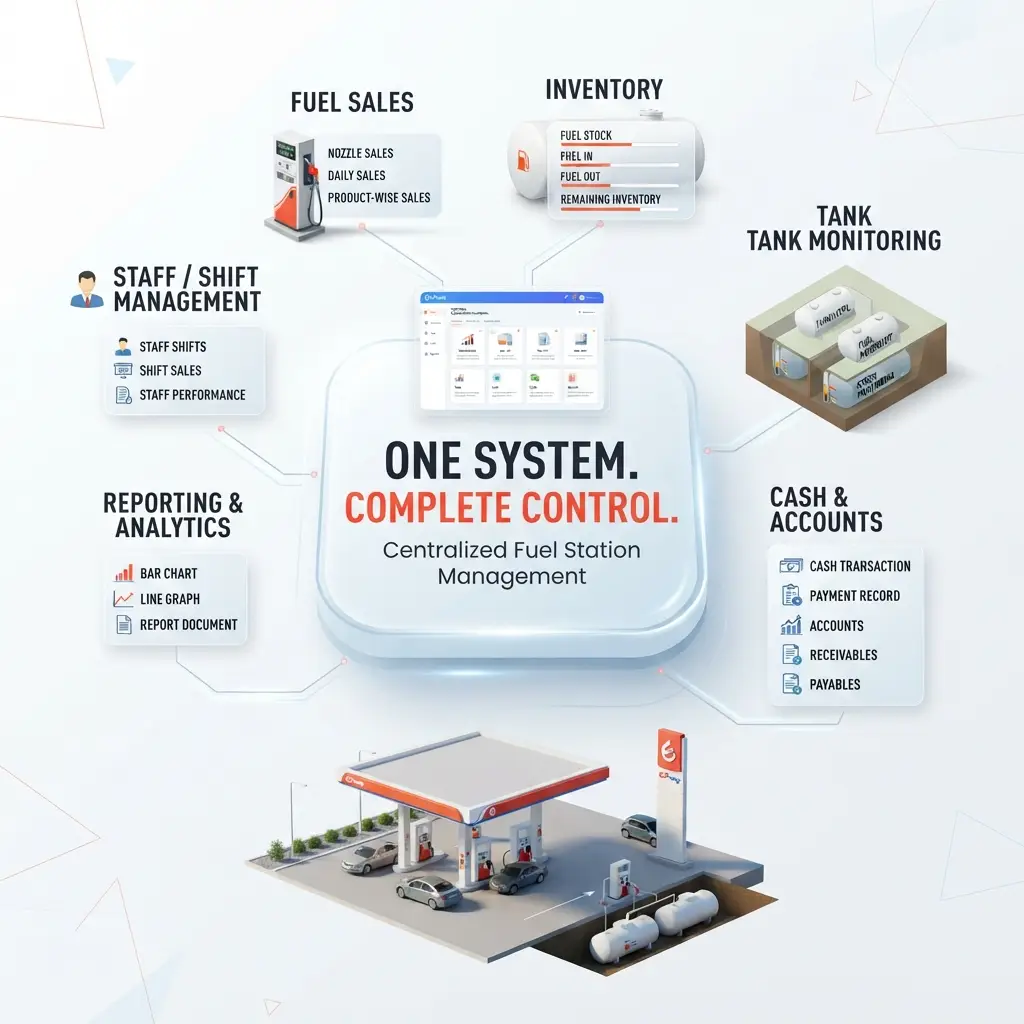
Introduction of Centralized Fuel Station Management System
Running a petrol pump today is very different from what it was a few years ago.
Operations have become more complex. Fuel prices fluctuate frequently, reporting requirements are increasing, and owners are expected to maintain tighter control over stock, sales, and cash flow. At the same time, many fuel stations in Pakistan are still relying on manual systems or disconnected software that creates confusion instead of solving problems.
This is exactly why more businesses are now moving toward a centralized fuel station management system.
Instead of managing sales in one place, stock in another, and reports separately, a centralized system connects everything into one platform. It gives petrol pump owners a clear view of their entire operation—live, accurate, and accessible anytime.
And honestly, in today’s fuel industry, that level of control is becoming essential.
The Daily Challenges Petrol Pump Owners Face
Most people outside the fuel industry don’t realize how difficult it is to manage a petrol pump efficiently.
Every single day involves:
- Monitoring nozzle sales
- Checking underground tank stock
- Managing cash handling
- Supervising staff shifts
- Verifying inventory
- Preparing reports
- Handling vendor coordination
And if these tasks are managed separately, problems begin to appear very quickly.
The Problem with Disconnected Operations
Many petrol pumps still use a mix of:
- Manual registers
- Excel sheets
- Separate accounting software
- Verbal staff reporting
- Physical stock checking
At first, this may seem manageable. But over time, disconnected systems create operational gaps.
For example:
- Sales reports may not match stock levels
- Cash records may differ from actual sales
- Tank readings may not be accurate
- Owners may receive delayed information
When everything operates separately, it becomes difficult to identify where problems are happening.
What is a Centralized Fuel Station Management System?
A centralized fuel station management system is a platform that connects all fuel station operations into one system.
Instead of handling sales, inventory, accounts, and reporting separately, everything is integrated together.
This includes:
- Fuel sales monitoring
- Inventory management
- Tank level tracking
- Shift management
- Cash flow monitoring
- Reporting and analytics
- Vendor and dispatch tracking
All information becomes available through one dashboard.
That means petrol pump owners no longer need to depend on multiple reports or manual calculations to understand their business.
Why Traditional Management Methods Are No Longer Enough?
The fuel industry has changed.
Margins are tighter. Competition is stronger. Operational costs are increasing.
In this environment, traditional systems create more risk than reliability.
- Manual Reporting Causes Delays
Most manual reporting systems only provide information at the end of the day.
But operational problems happen in real time.
If a discrepancy occurs during a shift, delayed reporting means:
- The issue stays unnoticed
- Losses continue
- Accountability becomes difficult
By the time the owner reviews the report, the problem may already be impossible to trace.
- Human Error Affects Accuracy
No matter how experienced staff members are, manual work always carries risk.
Common issues include:
- Incorrect sales entries
- Wrong calculations
- Missing records
- Inconsistent stock updates
Even small mistakes create confusion between:
- Sales
- Inventory
- Cash flow
And over time, these inconsistencies directly affect profitability.
- No Real-Time Visibility
One of the biggest problems petrol pump owners face is lack of visibility.
Without a centralized system:
- Owners cannot monitor operations live
- Stock levels remain uncertain
- Fuel losses become harder to detect
- Decision-making slows down
Many owners only discover issues after financial damage has already occurred.
- Staff Dependency Increases Operational Risk
In disconnected systems, owners often rely completely on staff reporting.
This creates serious operational dependency.
When there’s no centralized monitoring:
- Verification becomes difficult
- Shift accountability weakens
- Errors go unnoticed
- Transparency decreases
This doesn’t always mean dishonesty. Sometimes the issue is simply lack of system control.
The Real Cost of Poor Fuel Station Management
The biggest danger is not always visible loss.
It’s the gradual impact of inefficiency.
Fuel Loss and Pilferage
Small discrepancies in fuel stock may seem minor daily, but monthly losses can become significant.
Without system integration:
- Fuel sold may not match actual stock
- Tank variations remain unnoticed
- Pilferage becomes difficult to identify
Cash Handling Issues
When cash and sales are managed separately:
- Reports become inconsistent
- Reconciliation takes longer
- Financial accuracy decreases
This creates stress for both owners and accounting teams.
Time Wastage
Manual operations consume valuable time:
- Preparing reports
- Checking calculations
- Matching records
- Reviewing stock manually
A centralized system reduces these repetitive tasks significantly.
Poor Decision-Making
Business decisions are only as good as the data behind them.
If information is delayed or inaccurate:
- Purchasing decisions suffer
- Inventory planning weakens
- Operational control declines
How a Centralized Fuel Station Management System Solves These Problems?
This is where modern fuel management technology changes everything.
Instead of disconnected workflows, a centralized system creates one connected operational structure.
Real-Time Sales Monitoring
Every sale is tracked automatically.
Owners can monitor:
- Nozzle-wise sales
- Shift-wise sales
- Product-wise sales
- Daily performance
All in real time.
This improves visibility and reduces dependency on manual reporting.
Integrated Inventory Management
Inventory becomes far more accurate when connected directly to sales data.
The system tracks:
- Fuel in
- Fuel out
- Remaining stock
- Reorder levels
Everything updates automatically.
This eliminates confusion between physical stock and reported inventory.
ATG Integration for Accurate Tank Monitoring
Modern systems integrate with ATGs (Automatic Tank Gauging systems).
This allows petrol pumps to monitor:
- Tank fuel levels
- Fuel movement
- Stock discrepancies
Without manual dipping.
Real-time tank visibility significantly improves operational accuracy.
Centralized Dashboard for Complete Visibility
One of the biggest advantages of a centralized fuel station management system is the dashboard.
Instead of checking multiple reports, owners can view:
- Sales
- Inventory
- Cash flow
- Receivables
- Payables
- Fuel stock
- Reports
On one screen.
This saves time and improves decision-making.
Automated Reporting
Manual reporting consumes time and often includes mistakes.
A centralized system generates:
- Daily reports
- Weekly reports
- Monthly reports
- Yearly summaries
Automatically.
This improves efficiency and ensures better accuracy.
Better Shift Management
Shift-wise operations become easier to manage.
Owners can track:
- Staff performance
- Shift sales
- Fuel variances
- Operational activity
This creates stronger accountability.
Benefits of a Centralized Fuel Station Management System
Now let’s talk about the practical business benefits.
- Reduced Fuel Losses
Integrated systems quickly identify discrepancies between:
- Sales
- Stock
- Tank levels
This helps reduce fuel loss and operational leakage.
- Improved Transparency
Every transaction becomes traceable.
This improves trust within operations and strengthens overall monitoring.
- Faster Decision-Making
When accurate information is available instantly, owners can make faster and smarter business decisions.
- Better Operational Control
Even if the owner is not physically present at the station, operations remain visible and manageable.
- Increased Efficiency
Automation reduces manual work and speeds up workflows across departments.
- Stronger Financial Accuracy
Integrated sales and accounting systems improve reconciliation and reporting accuracy.
Why This Matters Specifically in Pakistan?
The fuel industry in Pakistan faces unique operational challenges.
These include:
- High staff dependency
- Manual working environments
- Tight profit margins
- Increasing fuel monitoring requirements
- Lack of operational transparency
In such conditions, centralized management systems are no longer optional.
They are becoming necessary for sustainable operations.
The Growing Shift Toward Digital Fuel Management
Across Pakistan, more fuel stations and OMCs are moving toward digital solutions because they understand one thing clearly:
Manual systems limit growth.
A centralized fuel station management system creates:
- Better structure
- Better monitoring
- Better reporting
- Better control
And most importantly, it helps owners run their businesses with confidence.
Why Choosing the Right Company Matters?
Not every software solution understands fuel station operations properly.
A professional company should offer:
- Industry-specific experience
- ATG integration support
- Real-time monitoring
- Reliable reporting
- Easy-to-use dashboards
- Local operational understanding
The system should solve practical fuel station problems—not create new technical complications.
Where EzPump Fits in?
This is where EzPump plays an important role.
EzPump is designed specifically for fuel stations and OMCs in Pakistan.
It connects:
- Sales management
- Inventory tracking
- Tank monitoring
- Accounts management
- Reporting systems
Into one centralized platform.
Instead of relying on disconnected operations, petrol pump owners can monitor everything through one system designed around real-world station requirements.
The Future of Fuel Station Operations
The fuel industry is moving toward automation, transparency, and real-time monitoring.
Petrol pumps that continue relying on outdated systems may struggle with:
- Inefficiency
- Loss control
- Reporting accuracy
- Operational visibility
A centralized system prepares fuel stations for the future.
And honestly, that transition has already started.
Conclusion
Managing a petrol pump through disconnected systems creates unnecessary complexity.
Sales operate separately. Inventory is tracked manually. Reports arrive late. Accountability becomes unclear.
A centralized fuel station management system changes this completely.
It connects every operational area into one platform, improving visibility, reducing losses, and simplifying daily management.
For petrol pump owners in Pakistan, this is no longer just about technology.
It’s about gaining control, improving efficiency, and protecting profitability in a highly competitive industry.